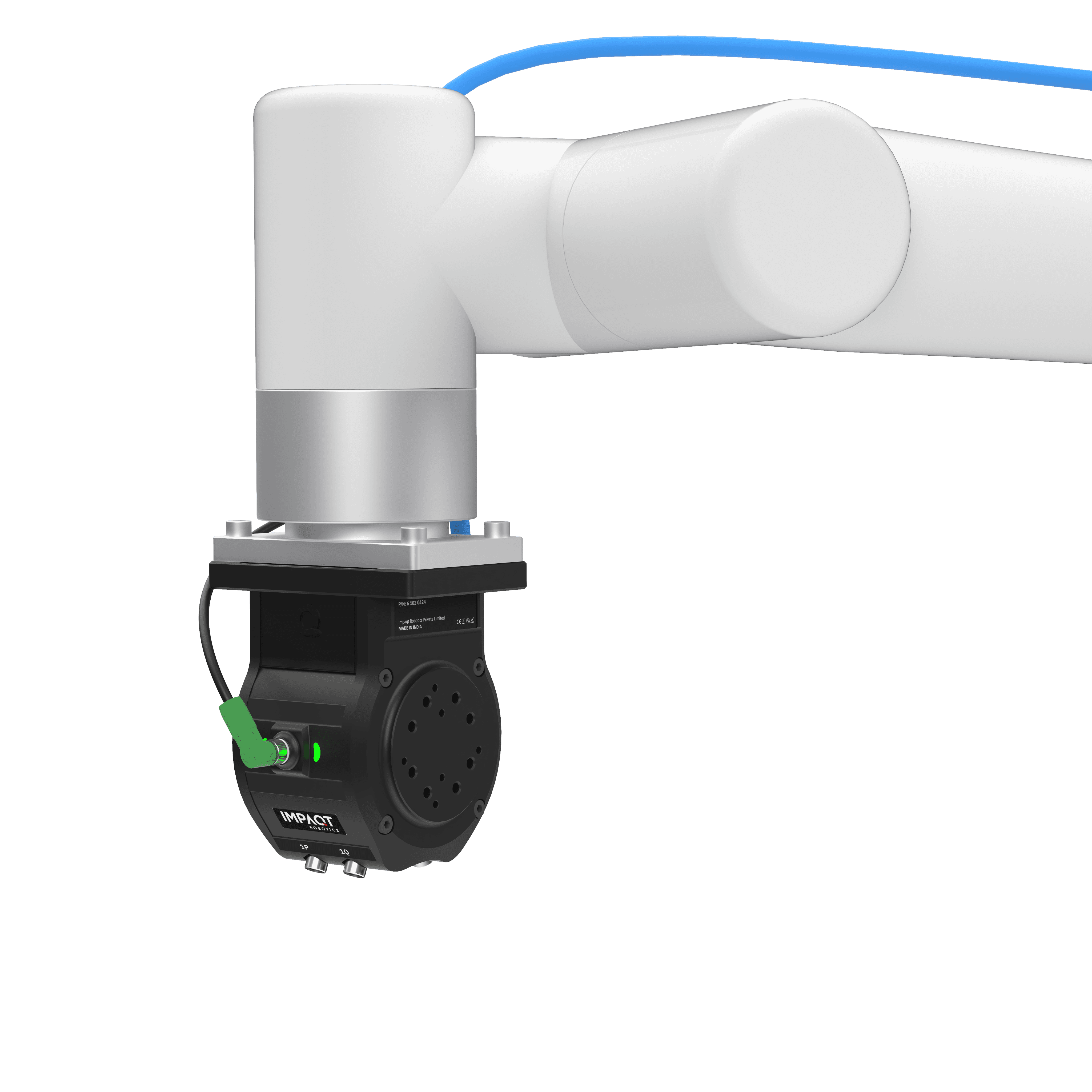
Dual pneumatic EOAT interface with 180° tandem layout
pneumagiQ PQ180T mounts two pneumatic grippers opposite each other in a 180° tandem layout. It is built for 10 kg handling setups where two grippers must enter a constrained machine envelope from opposite tool faces, such as CNC tending, gantry loading, or fixture-based part transfer.
Key Features
Provides a defined 180° two-gripper geometry
Eliminates the need for custom brackets and adapters
Reduces external pneumatic routing
Mounts two grippers in a fixed tandem layout
Integrates air distribution and valve control
Supports sensor feedback and blow-off functionality
Compact, wrist-mounted interface
Minimizes external components around the robot wrist
Simplifies routing, protection, and servicing
Ideal for tight machine cells


1046 grams
Maximize robot payload utilization

180° Tandem Layout
Two grippers mounted opposite each other

10 kg Payload
High-payload performance for heavier handling

4 Sensor Ports
No more long wires for sensors

Air Blow-Off Port
Easily clears chips, oil, and burrs
Scroll to view product

In machine tending and gantry loading, the EOAT is often limited by the machine opening, chuck position, fixture geometry, or available clearance around the part. PQ180T gives two pneumatic grippers a fixed 180° tandem arrangement, so the tool can be designed around the required approach path instead of adding custom brackets and external pneumatic components around the robot wrist.
This is useful when raw and finished parts are handled in the same cycle, or when a part has to be loaded, unloaded, or repositioned through a narrow access area. As part of the pneumagiQ platform, PQ180T is built to work with different pneumatic grippers and EOAT configurations, not one fixed tool brand or one custom setup. This makes it easier to adapt the same interface concept when the part, gripper, or application changes, without rebuilding the pneumatic architecture from scratch.
PQ180T is available with dedicated plugins for Universal Robots and FANUC CRX robots, allowing users to configure and operate the pneumatic grippers directly from the robot interface without an additional controller.
For other robots, cobots, gantries, and custom-built machines, PQ180T supports Modbus RTU over RS-485. This makes it suitable for integration across a wide range of automation platforms, including machine tending cells where the pneumatic interface is controlled through a PLC or external controller.
Standard, globally available converters can be used to interface RS-485 with other communication protocols such as TCP/IP or IO-Link when required.