ARTICLES
What actually matters when choosing how to automate case forming
Walk through almost any automated packaging line and you will see the same pattern. Products are moving, robots are placing, packing, or palletizing, and most of the system is optimized for speed and consistency. But early in the process, before anything can be packed, cartons still need to be formed.
That step is often treated as straightforward, and in many cases it is. A flat carton comes in, it gets opened, and the line moves on. The real question is not whether it can be done, but how that step is handled once requirements start to shift, whether that is throughput, layout constraints, or changing carton formats.
Where case forming fits in the line
Case forming sits at the beginning of the packaging process. Flat cartons are introduced, opened, and prepared before any product is packed or handled further downstream. Because it happens early, any instability here tends to affect everything that follows.
At the same time, it is often defined late in a project, once the rest of the line is already planned. That combination is where small issues start to turn into operational problems.
The main ways case forming is handled
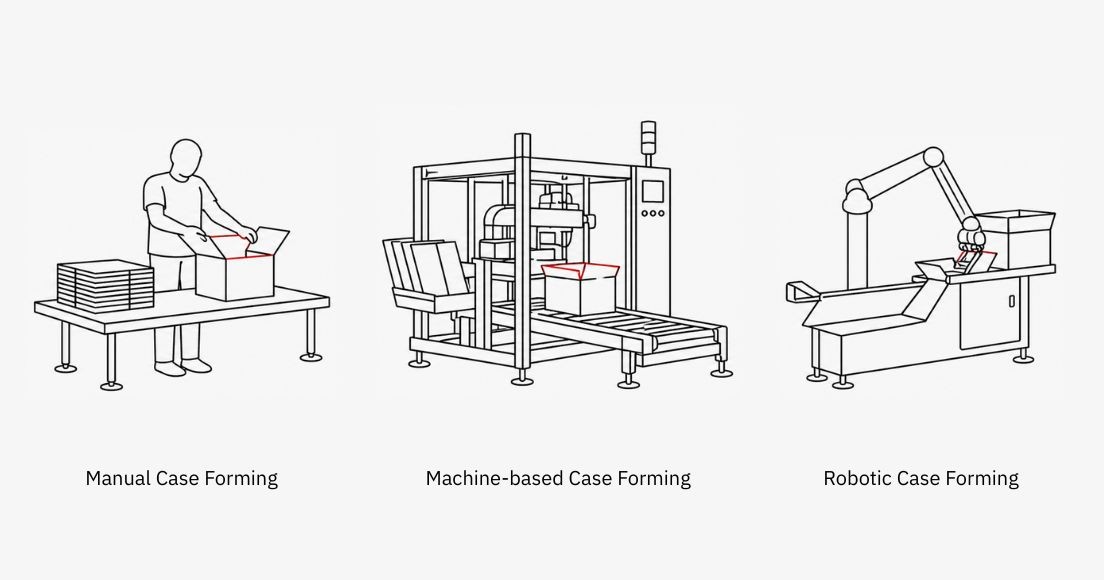
In practice, case forming is handled in three ways. For lower volumes or high-mix environments, cartons are still formed manually. In more automated setups, machine-based solutions such as carton erectors are typically used. In applications where flexibility or variation becomes important, robotic case forming has become an alternative.
All three approaches solve the same task. A flat carton needs to be opened and delivered in a formed state. The differences start to appear in how each approach is designed to operate, including throughput, footprint, and how easily it can handle changes in format or layout over time.
Where machine-based case forming works well
Machine-based solutions like carton erectors are built for consistency. When the carton format is known and unlikely to change, they provide a predictable and efficient solution. The system is set up, tuned for that specific format, and then runs with very little variation. In high-throughput environments, that reliability is exactly what is needed.
That level of optimization comes with trade-offs. These machines are typically designed with a fixed footprint and a defined position in the line. They take up space, require integration around them, and are not easily moved once installed. In stable production environments, this is not a limitation. In more dynamic setups, it becomes part of the constraint.
When requirements change, the impact becomes more visible. Adjustments are not always limited to simple configuration. Changes in carton size, format, or material can require mechanical modifications or additional setup work to maintain performance. The system continues to do its job well, but within the conditions it was originally designed for.
Where robotic case forming becomes relevant
Robotic case forming is typically used in applications where flexibility or reuse is required, rather than being tied to a single fixed setup. This can include environments with multiple box sizes, changing packaging requirements, or the need to deploy the same solution across different lines or sites.
The process itself does not change. Cartons are still presented, picked, and formed. What changes is how the system adapts when something in that process shifts.
In high-throughput, fixed-format applications, machine-based systems are typically faster and more optimized for output than robotic setups. Robotic case forming prioritizes adaptability, which makes it a better fit for variable environments, even if absolute output is not the only priority.
At the same time, robotic systems can offer advantages in terms of footprint and deployment. Compared to large, fixed machines, robot-based setups are often more compact and easier to integrate into existing layouts. This is especially relevant in environments where space is limited or where systems need to be reconfigured over time.
Why a robotic approach is chosen
Robotic case forming is not typically introduced because the forming task itself is difficult. It is introduced when the application cannot be reduced to a single fixed setup.
This can be due to variation in carton sizes, changes in packaging over time, or the need to standardize how case forming is deployed across multiple lines. In these situations, the goal is not just to automate the task, but to avoid rebuilding the solution each time requirements change.
In simple terms, a robotic approach is chosen when case forming needs to handle change without being redesigned for every new application.
This is also where collaborative robots often come into play, particularly in environments where manual forming is being replaced and space or flexibility are constraints. They allow automation to be introduced without large, dedicated machinery, while still handling variation more effectively than fixed setups.
What actually drives the choice
The decision between approaches comes down to how stable the application is expected to be.
For fixed, high-volume production with stable formats, machine-based case forming remains a strong and efficient solution. Where variation is part of the reality, whether driven by product mix, packaging changes, or scaling across sites, robotic case forming becomes more relevant. Manual forming still has its place in low-volume or highly flexible environments where automation is not justified.
The differences between these approaches are not about whether the task can be completed, but about how each system balances speed, footprint, flexibility, and the effort required to adapt when conditions change.
Where this leads next
Understanding when a robotic approach makes sense is only the starting point. The next step is how to implement case forming in a way that does not bring back the same engineering effort with every new application.
In many robotic setups, the flexibility comes from the robot itself, but the surrounding system still needs to be designed and built for each project. That is often where the same work returns. This is also where more system-based approaches start to make a difference. Instead of treating carton presentation, picking, and forming as separate problems, they are defined as part of a single, repeatable process. At Impaqt Robotics, this is the thinking behind casemagiQ, where case forming is approached as a defined system rather than a custom build each time.
You can see how this approach translates into practice in our breakdown of case forming from flat to formed in minutes.
Taking the next step
If you are evaluating how to automate case forming or looking to move from fixed setups to something more flexible, it helps to look at the full system rather than individual components.
We work with integrators and manufacturers to define and deploy case forming setups that are easier to reuse, adapt, and scale across applications. If that is something you are currently exploring, feel free to reach out or take a closer look at how casemagiQ is applied in real projects.
Final takeaway
Case forming is not a complex task, but the way it is implemented has a lasting impact on how a packaging line performs over time. The choice is not just about how to form a carton, but about how the system will handle change.