ARTICLES

Robots have become easier to access, but many projects still lose time in the engineering work required to turn automation concepts into reliable production systems.
In many automation projects, the application is understood, the business case is clear, and the right robot can often be selected relatively early. The timeline usually starts to stretch later, when the project moves from selecting the robot to building a system that can operate reliably on the production floor.
It was this recurring pattern that eventually became the foundation of Impaqt Robotics. Through years of designing and deploying robotic applications, one observation kept repeating. Different applications may look very different from the outside, but within each application area, many of the same deployment challenges kept reappearing from project to project. A machine tending cell, a palletizing setup, a case forming application, and a packaging project all require different final solutions, but each involves engineering work around the robot that is solved repeatedly across similar projects. Configuring tooling, managing utilities, routing cables and tubing, integrating sensors, and making the installation reliable enough for production are rarely one-time challenges.
Why deployment speed matters now
This is one of the less discussed realities of automation. Robots have become easier to buy, program, and support, but many implementation challenges remain familiar. The World Economic Forum reports that 63% of employers identify skills gaps as a major barrier to business transformation between 2025 and 2030 [1], while the International Federation of Robotics reports that manufacturers installed 542,000 industrial robots globally in 2024, more than double the number installed ten years earlier [2]. Manufacturers are investing in automation because they need to increase capacity, improve consistency, and reduce dependency on labor that is becoming increasingly difficult to find.
The pressure to automate is real, but moving from a successful project to repeatable deployment remains a challenge for many manufacturers. McKinsey research found that at least 70% of manufacturers become stuck in what it calls "pilot purgatory," where promising initiatives struggle to scale across operations [3]. While robot deployment presents different challenges than digital transformation programs, the underlying lesson is highly relevant: success depends not only on the technology itself, but on whether the surrounding processes and implementation work can be repeated efficiently and reliably.
Where automation projects actually lose time
A CNC machine tending application is a useful example because the task itself sounds straightforward: pick a raw part, load the machine, remove the finished part, and repeat. The challenge is that none of those actions happen reliably without the supporting setup around them. The project still depends on tooling, machine communication, sensor feedback, utility integration, air blow-off, and a physical installation that can survive years of production use.
The same principle applies across many automation applications. While the technical requirements differ, similar engineering work tends to repeat within each application area from project to project. The robot movement is often the easiest part of the project to understand, while much of the deployment effort sits in everything around it. Selecting the robot may take days. Completing the practical work that turns that robot into a functioning system can take considerably longer.
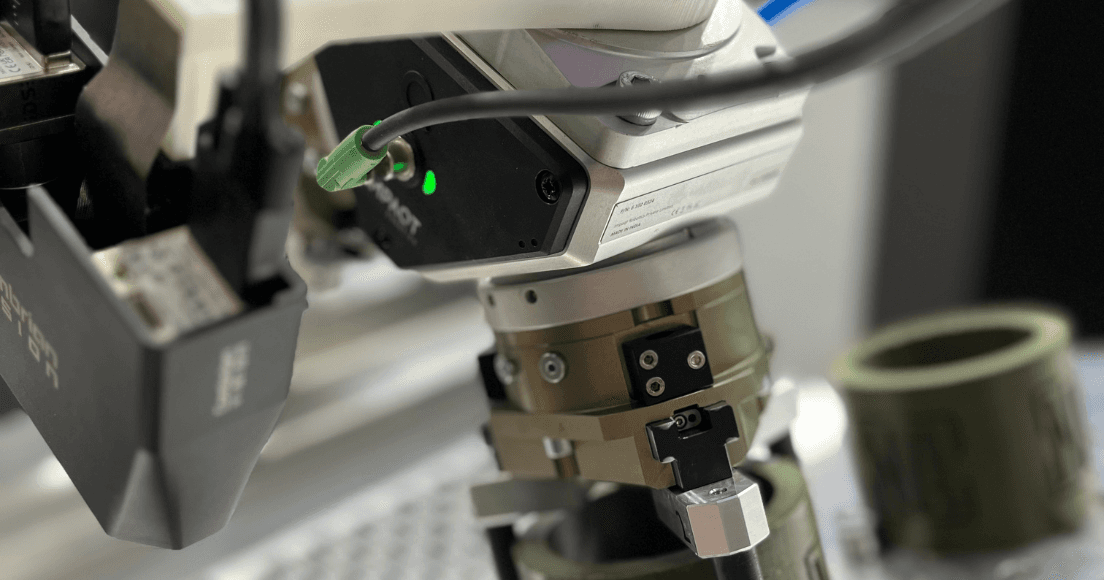
The same problems keep reappearing
As automation adoption grows, manufacturers are no longer thinking only about one robot in one cell. They are thinking about how automation can be repeated across more lines, more shifts, and sometimes more facilities. This is where traditional deployment approaches often begin to show their limitations. A custom solution may work well for a single application but still fail to create a repeatable path for the next one.
If every deployment starts with a new tooling layout, a new utility setup, and a new installation approach, automation remains possible but slow to scale. Fortune Business Insights projects the collaborative robot market to grow from USD 2.80 billion in 2026 to USD 13.27 billion by 2034 [4], which makes repeatability more than a technical preference. Manufacturers need ways to deploy automation without repeatedly solving the same supporting challenges from scratch.
From repeated engineering work to repeatable deployment
That observation became the foundation of Impaqt Robotics.
Rather than designing products around individual projects, we design them around recurring deployment challenges. The applications may be different, but many of the engineering tasks inside those applications are repeated again and again. That is where we focus.
This platform approach runs throughout the Impaqt Robotics portfolio. Instead of creating one-off solutions, we develop standardized building blocks that can be configured for different applications, robot brands, and production environments. The objective is not to standardize the application itself. Every production line is different. The objective is to standardize the engineering work that does not need to be reinvented every time.
Whether the challenge involves pneumatic integration, vacuum handling, modular gripping, case forming, palletizing, or robot installation, the underlying approach remains consistent: create products that reduce repeated engineering work while giving manufacturers and system integrators the flexibility to build the solution that fits their application.
Some custom engineering will always be necessary in automation. Every factory is different, every production line has its own constraints, and every application brings its own requirements.
The opportunity is not to remove engineering from automation. It is to stop spending engineering time on the same problems over and over again.
Sources
[1] World Economic Forum, Future of Jobs Report 2025
https://www.weforum.org/publications/the-future-of-jobs-report-2025/digest/
[2] International Federation of Robotics, Global Robot Demand in Factories Doubles Over 10 Years, 2025
https://ifr.org/ifr-press-releases/news/global-robot-demand-in-factories-doubles-over-10-years
[3] McKinsey & Company, Preparing for the Next Normal via Digital Manufacturing's Scaling Potential
[4] Fortune Business Insights, Collaborative Robots Market Size and Share Report, 2026–2034
https://www.fortunebusinessinsights.com/industry-reports/collaborative-robots-market-101692